Asking “how much does a website cost?” is a lot like asking about the price of a car. It all depends on what you need it to do.
A basic DIY website is like a reliable old ute, getting you online for a few hundred dollars a year. On the other hand, a custom-built e-commerce site from an agency is like a specialised commercial truck, designed for heavy lifting and costing tens of thousands.
This guide breaks down the real costs of building a website in Australia, from simple DIY projects to complex custom builds. You will learn what drives the price up, the pros and cons of different builders (DIY, freelancer, or agency), and the ongoing costs you need to budget for.
Table of Contents
- Your Quick Guide to Australian Website Costs
- Breaking Down the Core Website Cost Drivers
- Choosing Your Path: DIY vs. Freelancer vs. Agency
- How Much E-commerce Websites Really Cost
- The Hidden and Ongoing Costs of a Website
- Smart Budgeting Tips for Small Businesses
- Got Questions? We’ve Got Answers
Your Quick Guide to Australian Website Costs
Let’s cut straight to the chase. The first step in setting a realistic budget is understanding the typical price brackets here in Australia. Who builds your site, the complexity of the design, and the specific features you need to grow your business are the three biggest factors driving the final cost.
The path you choose will largely determine your initial investment. A simple informational site for a local plumber, for instance, will cost significantly less than a complex online store with hundreds of products and custom checkout functions.
Australian Website Cost Estimates at a Glance
To give you a clearer picture, here’s a quick breakdown of what you can generally expect to pay in Australia, depending on the type of provider you choose and your business needs.
| Website Type / Provider | Typical Price Range (AUD) | Best For |
|---|---|---|
| DIY Website Builders | $200 – $1,500 annually | Solopreneurs, hobbyists, or businesses testing an idea with a very tight budget. |
| Freelance Web Designer | $3,000 – $8,000+ | Small businesses needing a professional but straightforward brochure or lead generation site. |
| Small to Mid-Sized Agency | $8,000 – $25,000+ | Growing businesses requiring a custom design, specific integrations (like CRMs), and a strategic approach. |
| Large Agency / Custom Dev | $25,000 – $100,000+ | Established companies, e-commerce stores with complex needs, or businesses needing bespoke web applications. |
These figures are a starting point, of course. The final price tag always comes down to the specifics of your project, but this table should help you frame your budget conversations.
So, What’s the Average Price?
To give you a more concrete idea, a professionally designed website in Australia typically ranges from $3,500 to over $10,000 for a standard business site. From what we see in the market, the sweet spot for most small businesses lands somewhere between $5,000 and $8,000. At Strong Digital, we have fixed pricing for custom web design that starts at $5,499.
Of course, the market also has entry-level options like DIY website builders, which can get you started for as little as $200–$1,500 annually. At the other end of the spectrum, high-end custom solutions can easily exceed $25,000.
The most important thing to remember is that a website isn’t just an expense; it’s an investment in your business’s digital storefront. A well-built site can generate leads, drive sales, and build your brand’s credibility for years to come.
One of the biggest decisions you’ll make is choosing between a cheaper template-based solution and a bespoke build. While templates save you money upfront, a unique design almost always delivers better results in the long run. If you’re weighing your options, you might be interested in the top reasons you should invest in a custom website. This choice will be one of the biggest factors affecting your final quote.
Breaking Down the Core Website Cost Drivers
Ever wondered why one website costs $2,000 while another comes with a $20,000 price tag? It’s almost never about one single thing. Instead, it’s a mix of key ingredients that shape the final quote. Think of it like building a house: the final price depends on the size, the quality of the materials, and any special features you want, like a swimming pool or a home theatre.
The same logic applies to figuring out what your website should cost. The main drivers are the number of pages you need, how complex its features are, and the level of design customisation. This gives you a high-level view of how costs scale with complexity.
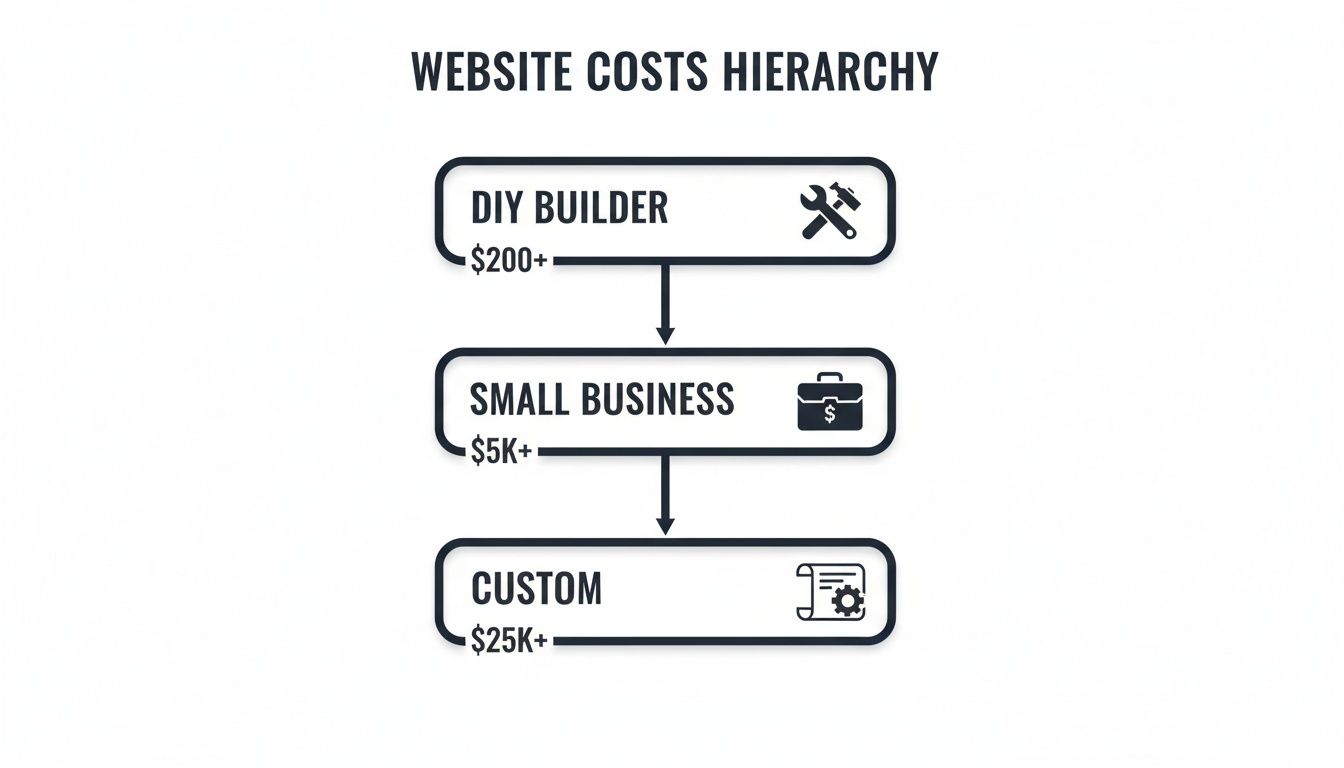
As you can see, the investment grows pretty quickly as you move from a basic DIY site to a fully custom build designed to meet specific business goals. Understanding the individual parts helps you have much smarter conversations with developers and ensures you only pay for what your business actually needs.
Web Design Customisation
The first big cost driver is the design itself. This is where your brand’s personality comes to life, and you have a few paths to choose from-each with a different impact on the budget.
- Template-Based Design: This is your most affordable option. It involves picking a pre-built theme and tweaking it with your brand’s colours, logo, and content. It’s fast and cost-effective, but the trade-off is that your site might look exactly like your competitors.
- Custom Design: This is a completely bespoke solution. A designer creates a unique website from scratch, tailored specifically to your business goals and who you’re trying to reach. It takes more time for strategy, wireframing, and design revisions, which bumps up the cost but gives you a one-of-a-kind digital presence.
A custom design doesn’t just look better; it’s also built around the user experience (UX), making sure visitors can find what they need without getting frustrated. This focus on usability almost always leads to higher conversion rates and a much better return on your investment.
Development and Functionality
While design is what your customers see, development is the engine under the hood that makes everything work. The complexity of the features you need is a massive factor in the final cost. A simple five-page “brochure” website with a contact form will be far cheaper than a site with more advanced functions.
Here are some common features that add to the development cost:
- E-commerce Capabilities: If you want to sell products online, you’ll need a shopping cart, payment gateway integration, and a system for managing inventory.
- Booking or Appointment Systems: Perfect for service-based businesses, this lets customers schedule appointments directly on your site.
- Membership Portals: If you plan to offer exclusive content to logged-in users, you’ll need a secure membership system built in.
- Third-Party Integrations: Connecting your website to other software-like a CRM, email marketing platform, or accounting tool-adds another layer of complexity and cost.
Every interactive element needs to be built, tested, and secured. Crucially, it must also work flawlessly on all devices. To get your head around this, it’s worth understanding what is responsive design and why it’s completely non-negotiable today.
Content Creation and SEO
A beautiful, functional website is pretty useless without high-quality content. You can always write it yourself to save some money, but professional copywriting and SEO are investments that pay for themselves over and over.
A website is your 24/7 salesperson. The words on the page are the sales pitch. Professional copywriting ensures that pitch is compelling, clear, and convincing enough to turn visitors into customers.
This part of the cost includes things like:
- Copywriting: Crafting persuasive text for your homepage, service pages, and about page that actually connects with readers.
- Photography and Videography: Sourcing or creating high-quality, professional visuals that make your brand look credible.
- On-Page SEO: Researching keywords and optimising your page titles, meta descriptions, and content to help you show up on Google.
Investing in SEO from the very beginning ensures your website is built on a solid foundation for long-term visibility. Skipping this step often means paying a lot more later to fix a site that search engines can’t properly understand. If you want to see how these different components come together in the real world, you can explore real-world pricing structures to see how service tiers are often bundled.
Choosing Your Path: DIY vs. Freelancer vs. Agency
Deciding who will build your website is one of the first big calls you’ll make. It’s a choice that goes way beyond the initial price tag-it shapes the quality, flexibility, and long-term potential of your entire online presence.
Think of it like renovating a kitchen. You could head to Bunnings, watch a few YouTube videos, and tackle it yourself. You could hire a skilled carpenter to build and install the custom cabinets you’ve designed. Or you could bring in a full-service building company to manage the whole project, from design and demolition to plumbing and painting.
Each route has its own trade-offs. The right one for you boils down to your budget, your technical skills, how much time you can sink into the project, and your ambitions for the business. Let’s break down the three main options so you can see where you fit.
The DIY Builder Route
Do-It-Yourself (DIY) website builders like Squarespace, Wix, or Shopify are the fastest and cheapest way to get online. They’re built for beginners, with drag-and-drop editors and pre-made templates that let you launch a basic site without touching a single line of code.
This path is a solid choice for businesses on a shoestring budget, hobbyists, or anyone wanting to test a business idea without a big upfront investment.
- Pros: Very low upfront cost, incredibly fast to launch, and you have complete control over every little detail.
- Cons: Customisation is limited, your site might end up looking a bit generic, and you’re on the hook for all maintenance, security, and troubleshooting.
- Best For: Solopreneurs, artists, or micro-businesses that just need a simple online brochure or portfolio.
While DIY builders are fantastic for getting off the ground, their limitations can start to chafe as your business grows. You might hit a wall with the platform’s features, find you can’t add custom functions, or struggle to properly optimise your site for search engines.
Hiring a Freelance Developer
The next step up is bringing in a freelance web developer or designer. This is a brilliant middle ground, giving you professional expertise without the overhead of a full agency. Freelancers are specialists who can build a custom site from the ground up that genuinely reflects your brand.
You get a direct, one-on-one relationship, working with the exact person doing the work. It’s a popular move for small businesses that have outgrown their starter site and need something more polished and unique. Research into the Australian web development industry shows that freelancers occupy a clear middle tier in pricing. For a basic project, a freelancer might charge anywhere from AUD $500 to $2,000, with costs climbing towards AUD $10,000 for more complex builds. As noted in recent Australian web design cost analyses, this pricing is a sweet spot for startups and small businesses.
- Pros: More affordable than an agency, direct line of communication, and far more customisation than any DIY tool.
- Cons: A freelancer is a single point of failure (what happens if they get sick or go on a long holiday?), their skills might be strong in design but not development (or vice versa), and ongoing support can sometimes be inconsistent.
- Best For: Small businesses ready for their first professional website or those needing a redesign with a very clear, defined scope.
Partnering with a Web Design Agency
Working with a web design agency is the premium option, and for good reason. An agency brings an entire team of specialists to your project-strategists, designers, developers, copywriters, and project managers. This collaborative approach means every single part of your website is handled by an expert.
An agency doesn’t just build you a website; they build a business asset. Their entire process is geared towards understanding your commercial goals and delivering a strategic solution designed to get real, measurable results, like generating qualified leads or driving sales.
While the upfront investment is higher, an agency delivers unmatched stability, a huge breadth of expertise, and reliable long-term support. They become a strategic partner invested in your growth. For a more detailed look at making this call, our guide on choosing between a DIY approach and hiring a professional can help you weigh the pros and cons.
- Pros: Access to a diverse team of experts, a strategic and goal-focused process, and dependable ongoing support and maintenance.
- Cons: The highest upfront cost of the three options and potentially longer project timelines because of the more structured, in-depth process.
- Best For: Established or growing businesses that see their website as a critical marketing and sales engine and want a long-term partner to help drive that growth.
Comparing Website Builder Options: DIY vs. Freelancer vs. Agency
To make the decision a little easier, we’ve broken down the key differences in this table. Think about what matters most to you-cost, speed, quality, or long-term support-to find the best fit.
| Factor | DIY Builder (e.g., Wix) | Freelancer | Web Design Agency |
|---|---|---|---|
| Upfront Cost | Very Low ($0 – $500) | Moderate ($500 – $10,000) | High ($10,000+) |
| Time to Launch | Very Fast (Days to weeks) | Moderate (Weeks to months) | Slower (Months) |
| Quality & Customisation | Low (Template-based) | High (Custom-built) | Very High (Strategic & custom) |
| Expertise | Your own skills only | One specialist’s skills | A full team of specialists |
| Ongoing Support | Your responsibility | Can be inconsistent | Structured & reliable |
| Best For | Hobbyists, testers, very small budgets | Small businesses with clear needs | Growing businesses needing a strategic asset |
Ultimately, there’s no single “best” choice-only the best choice for your business right now. A DIY site might be perfect for launching, but an agency partner could be what you need to scale. Understanding these trade-offs is the first step to making a smart investment in your digital future.
How Much E-commerce Websites Really Cost
Selling online adds a whole new layer of complexity to a website, and the cost naturally follows suit. An e-commerce site isn’t just a digital brochure-it’s a fully functional, 24/7 digital storefront. It needs to handle a secure shopping cart, reliable payment processing, inventory tracking, and customer accounts just to get off the ground.
Stepping into e-commerce means you’re moving beyond a simple informational site into the world of a dynamic, transactional platform. This is where the answer to “how much should a website cost?” jumps significantly higher, but for very good reasons.
Key Features Driving E-commerce Costs
The price of an online store is directly tied to the specific features you need to sell your products effectively and give customers a smooth ride. Unlike a simple business website, these elements are non-negotiable if you’re serious about online retail.
Here are the core components that add to the cost:
- Platform Selection and Setup: Your first big decision is choosing the right platform. Options like Shopify or BigCommerce offer a streamlined, all-in-one solution with monthly fees. On the other hand, platforms like WooCommerce (for WordPress) give you more flexibility but need more development work. Each path has different upfront and ongoing costs.
- Payment Gateway Integration: To actually take people’s money, you need to connect with secure gateways like Stripe, PayPal, or eWay. This isn’t just a flick of a switch; it involves setting up the connection, making sure it’s iron-clad secure, and testing it thoroughly to avoid transaction errors that kill sales.
- Product Catalogue Complexity: How many products you sell and how complicated they are (think size, colour, material variations) directly impacts development time. A store with 10 simple products is a world away from building one with 500 products, each with multiple customisable options.
- Shipping and Logistics: Getting shipping rules right can be surprisingly tricky. This involves setting up flat rates, calculating live shipping costs based on weight and location, and integrating with Australian carriers like Australia Post or Sendle.
Platform Choices and Their Cost Impact
Your choice of e-commerce platform is one of the biggest levers on your budget. You can think of it as choosing between renting a retail space in a managed shopping centre (like Shopify) or building your own standalone store from the ground up (like WooCommerce).
Shopify’s subscription model is great for predictable monthly costs but can be more restrictive on customisation. A custom WooCommerce build, however, has a higher upfront cost but gives you complete ownership and control over features and design. Making the right call depends entirely on your business model and where you plan to be in a few years.
If you’re weighing your options, our detailed e-commerce platform comparison can help you figure out the best fit for your specific needs.
An e-commerce website is an active business tool, not a static page. It requires a greater investment because it’s designed to actively generate revenue, manage operations, and interact with customers in real-time.
The Average Investment for an Online Store
So, what should you really budget? Because of all these extra functional needs, e-commerce websites sit in a distinct market segment, often requiring an investment between AUD $8,000 to $20,000+.
For businesses that need a truly professional and reliable online presence, Australian web design agencies typically charge anywhere from AUD $5,999 to over $25,000. That premium pricing is justified by things like a fully custom design, professional copywriting for all your product descriptions, and ongoing support.
While the initial investment is significant, a well-built e-commerce site quickly becomes a powerful asset that drives sales and delivers a strong return.
The Hidden and Ongoing Costs of a Website
It’s a common mistake to think your website cost ends the day it goes live. In reality, launching your site is just the beginning. Like any valuable business asset-a company car or a retail shopfront-a website needs ongoing investment to stay secure, functional, and effective.
Answering “how much should a website cost?” means looking beyond the initial build. These recurring expenses are just as crucial as the design and development fees because they keep your digital investment working for you, not against you.
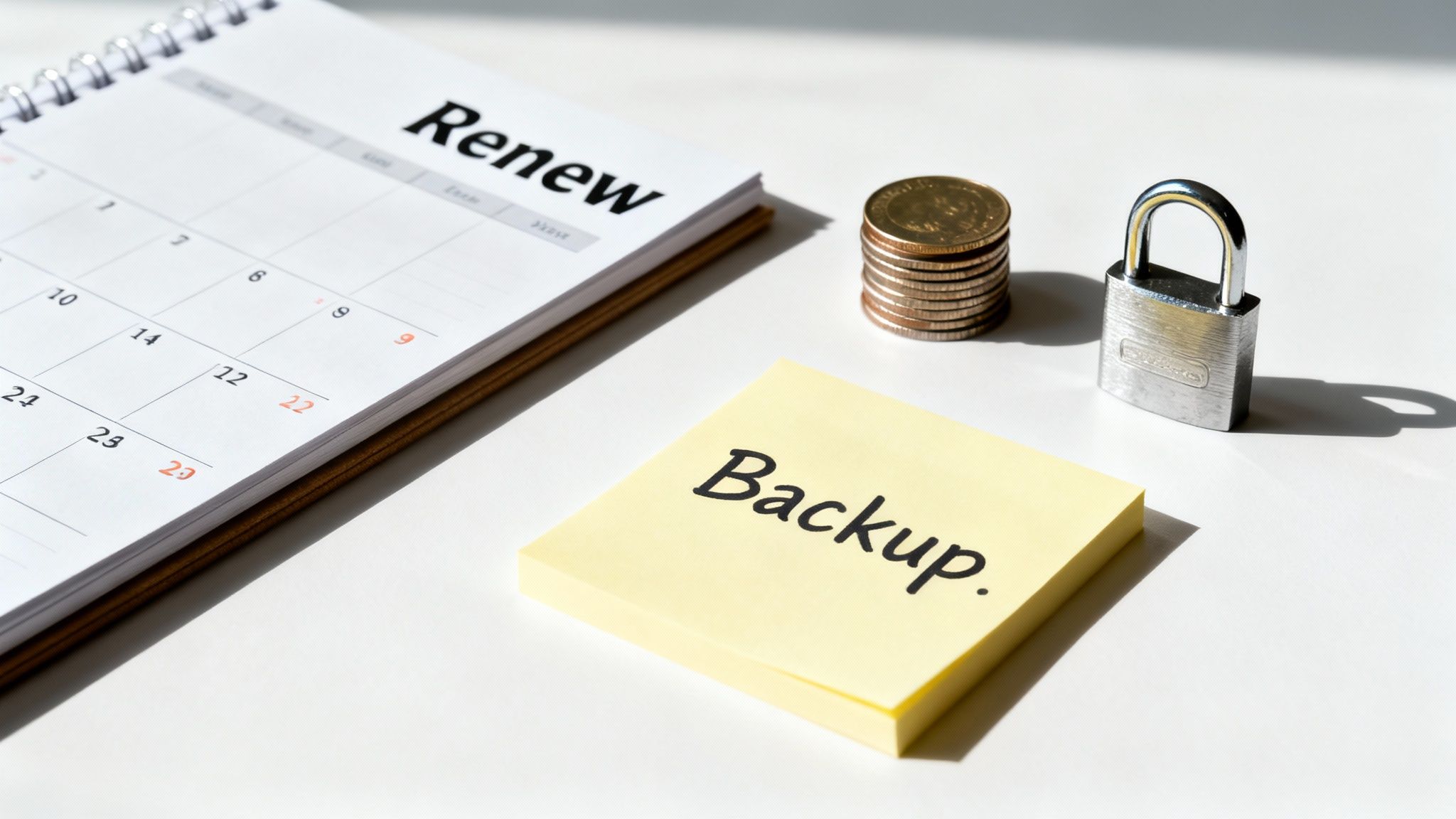
Core Recurring Expenses
At an absolute minimum, every website owner needs to budget for a few non-negotiable annual costs. These are the essentials that keep your site live and accessible on the internet.
- Domain Name Renewal: This is the yearly fee you pay to keep your website address (like
yourbusiness.com.au). It’s a small but critical expense, usually around $20 – $50 per year. If you forget to renew it, you could lose your domain name for good. - Web Hosting: Think of hosting as the plot of land your website lives on. It’s where all your files, images, and content are stored. Budget hosting can seem tempting, but cutting corners here often leads to slow loading times and poor security-both of which can sink your search engine rankings and frustrate users. Quality hosting in Australia can range from $150 to over $500 per year.
These two costs are the bare minimum. Without them, your website simply doesn’t exist online.
The Critical Cost of Website Maintenance
Beyond the basics, your most important ongoing investment is website maintenance. A website isn’t a static brochure; it’s a complex piece of software that needs regular care to function properly and securely. Neglecting this is like never servicing your car-things will eventually break down.
Website maintenance is preventative care for your digital asset. It’s the difference between a secure, high-performing site that generates leads and a slow, vulnerable one that becomes a liability.
Regular maintenance typically involves:
- Software and Plugin Updates: Platforms like WordPress and their plugins release updates constantly to patch security holes and fix bugs. Failing to update them leaves your site wide open to hackers.
- Regular Backups: If something goes wrong-whether it’s a server crash or a malicious attack-having recent backups of your website is your only safety net.
- Security Scans: Proactively scanning for malware and vulnerabilities helps you find and fix issues before they cause serious damage to your business or reputation.
Professional maintenance plans are a smart move. For a deeper dive into what’s involved, you can learn more about the importance of website care and why it’s a service you can’t afford to skip.
At Strong Digital, we roll our website maintenance and hosting into a single easy service to take care of your website.
Other Potential Ongoing Investments
Finally, there are other costs that might not be mandatory from day one, but are essential for growing your business and getting a real return on your investment.
- Premium Software Licences: Many websites rely on premium plugins or themes for specific functions, like advanced contact forms or e-commerce features. These often come with annual renewal fees.
- Digital Marketing Services: A brilliant website is useless if no one can find it. Ongoing services like Search Engine Optimisation (SEO) or paid advertising are crucial for driving traffic and generating leads.
- Payment Processing Fees: If you run an e-commerce store, every transaction will have a small fee attached. A thorough payment processing fees comparison can uncover potential savings and unexpected charges that eat into your margins.
Smart Budgeting Tips for Small Businesses
Knowing the costs is one thing, but making them work for a small business budget is a whole different ball game. The secret isn’t just about spending less; it’s about spending smarter. With the right strategy, you can get a high-performing website without torching your cash flow, making sure every dollar you put in actually brings something back.
It all starts with a mindset shift. Stop seeing a website as a one-off bill and start treating it like a hard-working business asset. A well-built, search-optimised site should be generating leads, closing sales, and building your brand’s credibility long after you’ve paid the final invoice.
Prioritise Features with a Staged Approach
It’s tempting to want every bell and whistle from day one, but that’s the fastest route to an empty bank account. Instead, borrow a page from the tech world and adopt a “Minimum Viable Product” (MVP) mindset. Think of it like opening a café: you start with amazing coffee and a couple of killer pastries. You don’t build a full commercial kitchen for a fancy dinner menu on day one.
For your website, that means launching with just the essentials.
- Core Pages: A clear homepage, a compelling about us page, detailed service or product pages, and a dead-simple contact page.
- Essential Functionality: A basic lead capture form and clear calls to action that tell visitors exactly what to do next.
- A Solid Foundation: A clean, professional design that works flawlessly on mobile and is built with SEO best practices from the ground up.
Once your foundational website is live and bringing in traffic or leads, you can reinvest those returns into adding more advanced features. This staged approach lets your website grow with your business, funded by its own success.
Invest in Quality for Long-Term Value
It’s so tempting to go for the cheapest option, but this is almost always a false economy. A poorly built site can end up costing you far more in the long run through lost sales, frustrating security holes, and expensive redevelopment work down the track.
Investing in quality from day one isn’t an expense; it’s a strategic business move. A well-crafted site becomes an asset that works for you 24/7.
The numbers back this up. Businesses that invest between AUD $9,997 and $14,997 for a custom 10-15 page WordPress site typically see performance metrics and conversion rates that are 3-4 times better than those using cheap, template-based solutions. You can discover more insights on Australian website performance to see just how well this kind of investment pays off.
Got Questions? We’ve Got Answers
Thinking about a new website is exciting, but the pricing side of things can feel like a maze. Let’s clear up some of the most common questions Australian business owners ask when they’re figuring out their budget.
What’s the Ballpark for a Simple 5-Page Website in Australia?
For a straightforward, professional 5-page informational website, you should expect to invest between $3,000 and $7,000. This isn’t just for a template; that price typically gets you a custom design that actually reflects your brand, works flawlessly on mobile, and has the basic on-page SEO foundations sorted by an experienced freelancer or a proper agency.
Sure, you can get the initial cost down with a DIY builder, but don’t forget to factor in the huge amount of your own time you’ll sink into it.
Can I Actually Get a Website Built For Under $1,000?
Yes, it’s definitely possible to get something live for under a grand. The most popular route is using a DIY platform like Squarespace or Wix, where you’re looking at a few hundred dollars a year in subscription fees.
Your other option is to find an overseas freelancer who can work within that budget. Just be prepared for potential headaches. From my experience, this path can often lead to quality issues, frustrating communication gaps, and zero reliable support when something inevitably breaks.
While you can get a site online for cheap, the real value comes from a professional build. Investing between AUD $6,000 to $12,000 with an agency delivers a far better long-term return through proper SEO, a site that can actually grow with you, and a final product that’s aligned with your business goals.
What Ongoing Costs Pop Up After My Website is Built?
Great question. A website isn’t a “set and forget” asset. There are a few essential running costs you need to budget for to keep it online, safe, and doing its job. Think of these as your non-negotiables:
- Domain Name Renewal: This is your website’s address. Expect to pay around $20-$50 per year to keep it.
- Web Hosting: This is the plot of land your website lives on. Good, reliable hosting will run you anywhere from $150-$500+ per year.
- Maintenance Plan: Absolutely crucial. This covers security updates, software patches, and regular backups. It’s your insurance policy, typically costing $50-$200+ per month.
Ready to stop guessing what your website should cost and start building a powerful asset for your business? At Strong Digital, we replace large upfront fees with a predictable monthly subscription that covers everything from strategy and custom design to ongoing management. Get a clear, fixed price for a website that grows with you.
Share To

Written ByNick Marden
Nick is the founder of Strong Digital. He’s been building websites since dial-up – starting in his bedroom in 1999, back when HTML felt like magic. These days, he leads the team at Strong, helping businesses grow with smart strategy, solid tech, and websites that actually pull their weight. Read more by Nick.